Table of contents
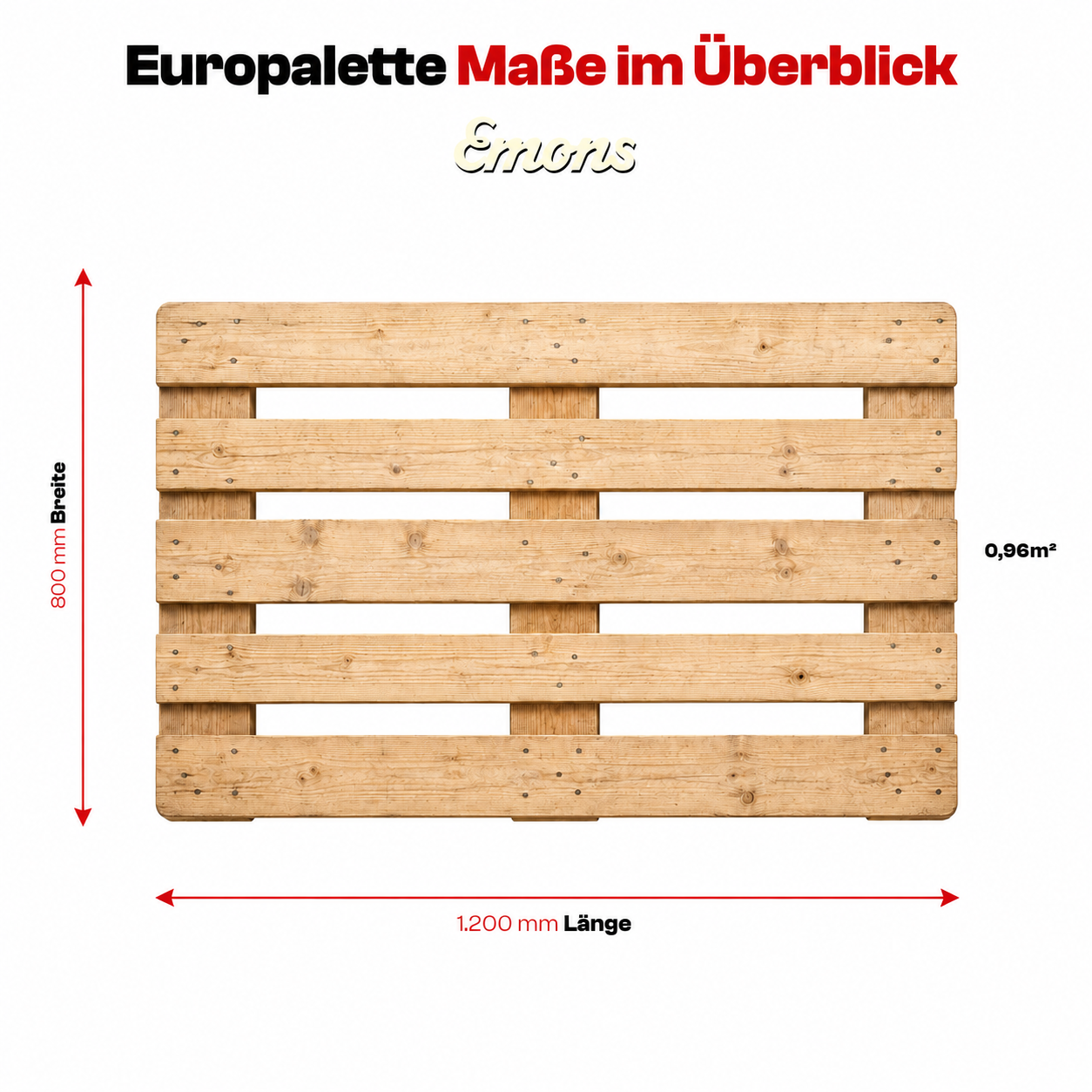
The Euro pallet measures 1,200 × 800 x 144 mm and is a standardized reusable pallet for storage, handling, and transport. Its uniform size makes it easy to integrate into trucks, racking systems, and general cargo networks.
Euro pallets are a logistical staple in warehousing, handling, and transport. They ensure that goods can be stored, moved, and loaded uniformly. For companies, it is particularly important to know how much space a Euro pallet requires, what weight must be factored in, and how many pallets fit into a truck.
What makes the Euro pallet so versatile?
Anyone shipping palletized goods needs a reliable basis for transport planning. The dimensions of a Euro pallet determine how much loading space is required, which vehicle is appropriate, and how accurately freight costs can be estimated. This makes Euro pallets a key planning metric, especially for general cargo, partial loads, and national road transport.
Planning a pallet shipment? Submit your non-binding freight inquiry or contact our road transport experts.
Euro pallet data: weight, load capacity, and shipment weight
In practice, an empty Euro pallet usually weighs about 20 to 25 kg. For transport planning, a dead weight of around 25 kg is often used. The exact weight can vary slightly due to factors such as wood moisture, age, repairs, or the general condition of the pallet.
It is important to distinguish between pallet weight and shipment weight. Pallet weight refers only to the empty pallet. Shipment weight, on the other hand, includes the entire shipping unit: goods, pallet, packaging, film, and strapping.
Therefore, the gross weight of the shipment is always what counts for planning. For example, a pallet with 720 kg of goods, 25 kg of pallet weight, and 5 kg of packaging material results in a shipment weight of 750 kg.
Weight affects not only freight costs but also vehicle selection. This is because a truck is limited not only by loading space but also by its permissible payload. Especially with heavy palletized goods, it should always be verified that the weight, weight distribution, and load securing are suitable for the planned transport.
How many Euro pallets fit into a truck?
The number of Euro pallets that fit into a truck depends on the loading length, interior width, payload, and loading method. As a general guide: a 7.5-ton truck often has space for about 15 Euro pallets, and a 12-ton truck for about 18. In practice, a standard semi-trailer usually holds 33 Euro pallets, or up to 34 if oriented optimally. Depending on the configuration, a truck-trailer combination can accommodate approximately 36 Euro pallets.
In practice, weight, stackability, packaging, and load securing also determine how the shipment can actually be loaded.
According to official EPAL data, the Euro pallet measures 1200 × 800 × 144 mm, weighs approximately 25 kg, and has a load capacity of 1,500 kg.
For truck planning, Euro pallets are often calculated at 0.40 loading meters; a standard semi-trailer is typically specified as having 13.60 loading meters.
Calculating loading meters for Euro pallets
Loading meters indicate how much length a shipment occupies on a truck's loading area. This metric is particularly useful for Euro pallets because it allows for a quick assessment of whether a shipment should be planned as general cargo, partial load, or a full truckload.
The formula is:
Loading meters = length × width ÷ 2.40 m
For one Euro pallet, this results in:
1.20 m × 0.80 m ÷ 2.40 m = 0.40 LDM
A single Euro pallet therefore corresponds to approximately 0.4 loading meters. 10 Euro pallets occupy about 4.0 LDM, 20 Euro pallets about 8.0 LDM and 33 Euro pallets about 13.2 LDM.
A loading meter calculator allows you to quickly estimate how much loading space a pallet shipment will occupy in a truck.
Why Euro pallets are important for freight costs
Euro pallets influence freight costs primarily through loading space, loading meters, weight, and vehicle utilization. A standard semi-trailer with a loading length of approximately 13.6 m is almost completely full with 33 to 34 Euro pallets. Volume, stackability, and potential overhangs also play a role. The more accurately the number of pallets, dimensions, weight, and stackability are specified, the better you can determine whether general cargo, partial loads, or full loads are the right transport solution.
Are you unsure whether your pallet shipment should be planned as general cargo, a partial load, or a full load?
Speak with our experts or submit your non-binding freight inquiry directly.
Preparing Euro pallets correctly for shipping
Euro pallets should be prepared for shipping in a way that ensures they can be safely loaded, transported, and delivered. Goods should be placed flush on the pallet and not extend beyond the edges. Overhang increases the risk of transport damage and can result in more loading space being required.
Weight distribution also plays an important role. Heavy goods should be placed as evenly as possible on the pallet to keep the load stable. Appropriate packaging, stretch wrap, strapping, or edge protectors further ensure that the goods do not shift during transport.
Clearly visible shipping labels and accurate information regarding dimensions and weight are also important. If a pallet is not stackable, this should be clearly marked. This allows freight forwarders to better plan which vehicle size is suitable and how the shipment can be safely placed in the truck.
Shipping Euro pallets with Emons
If you would like to ship Euro pallets nationally or internationally, Emons will support you with the right transport solution. Depending on the size of the shipment, general cargo, partial loads, or full loads may be suitable. The deciding factors are dimensions, weight, pickup and delivery locations, as well as requirements for transit time and handling.
For a realistic assessment, accurate information regarding the number of pallets, stackability, packaging, and the gross weight of the shipment is helpful. This makes it easier to plan which vehicle is suitable and which shipping solution is economically viable
Would you like to ship Euro pallets reliably?
Submit your no-obligation freight quote request to Emons.
FAQ about Euro pallets
What are the dimensions of a Euro pallet?
A Euro pallet has dimensions of 1,200 × 800 × 144 mm. The surface area is 0.96 m². This makes it easy to integrate into trucks, storage areas, and racking systems.
How much does a Euro pallet weigh?
In practice, an empty Euro pallet usually weighs about 20 to 25 kg. For transport planning, a dead weight of around 25 kg is commonly used. The actual weight may vary slightly depending on wood moisture, age, and condition.
How many Euro pallets fit into a semi-trailer?
In practice, a standard semi-trailer usually holds 33 Euro pallets. With optimal arrangement, it is theoretically possible to fit up to 34. The deciding factors are internal dimensions, weight, stackability, and load securing.
How do you calculate the footprint of a Euro pallet?
The footprint is calculated as length × width. For a Euro pallet, this results in 1.20 m × 0.80 m = 0.96 m². For the loading meter calculation, the formula is: 1.20 m × 0.80 m ÷ 2.40 m = 0.40 LDM.
Can I ship Euro pallets with Emons?
Yes. Depending on the size of the shipment, Euro pallets can be transported as general cargo, part loads, or full loads. For planning purposes, the number of pallets, dimensions, weight, stackability, as well as the pickup and delivery locations are important.
How much does it cost to ship a Euro pallet?
Costs depend on factors such as the pickup and delivery locations, weight, dimensions, stackability, transit time, and the desired mode of transport. For a precise estimate, please submit an individual freight inquiry.

.jpeg)