Table of contents
Container sizes at a glance: Dimensions of 20ft, 40ft, and High Cube containers, as well as FCL or LCL. Find the right container solution for your sea freight.
Container sizes play a central role when transporting goods internationally by sea. Whether it's machinery, commercial goods, raw materials, or packaged cargo: choosing the right container affects how efficiently a shipment can be planned, loaded, and transported.
For companies, it is particularly important to know which container sizes are available, how 20ft and 40ft containers differ, and when a High Cube container makes sense. The decision between FCL and LCL is also closely linked to volume, type of goods, and shipping requirements.
What does container size mean?
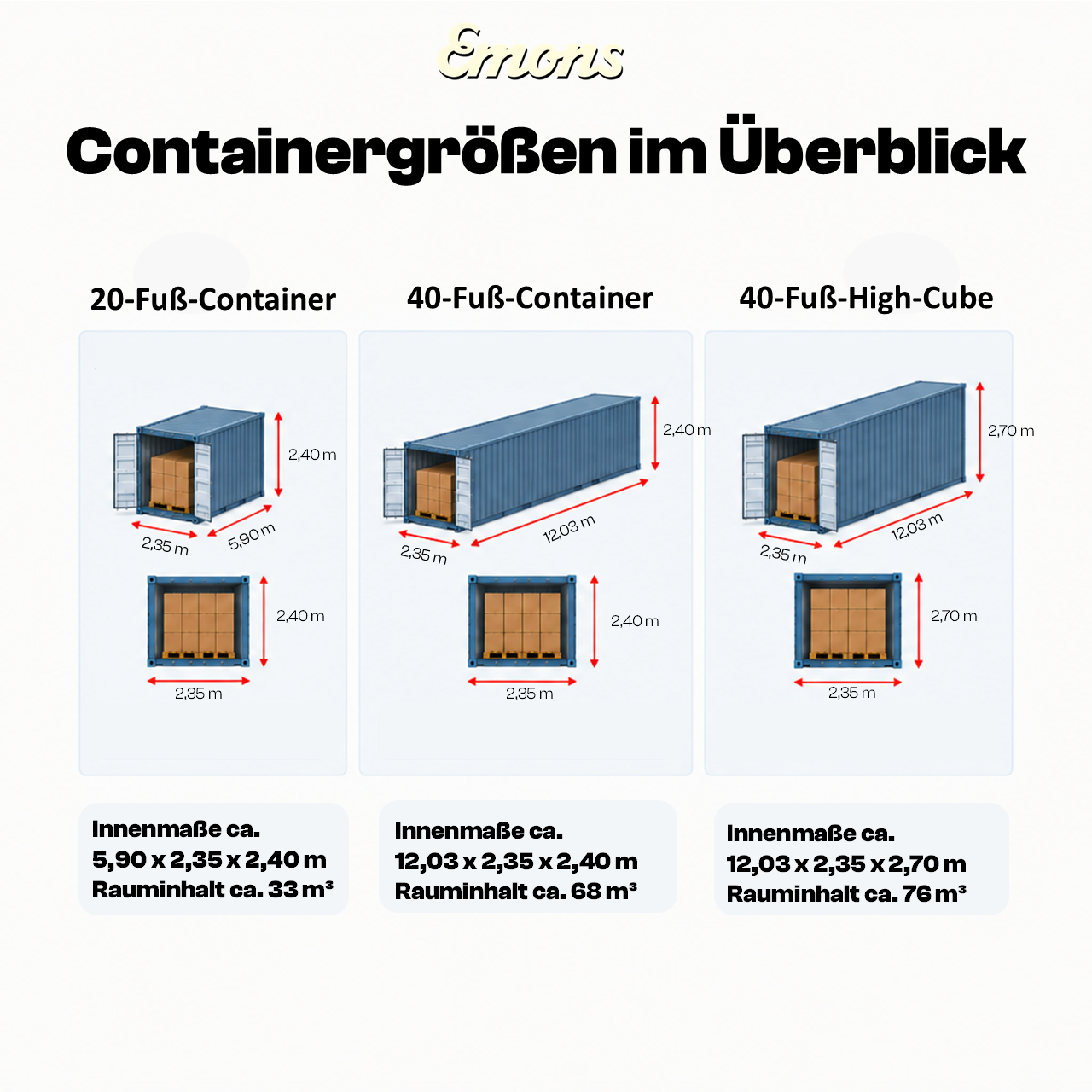
Container sizes describe the standardized dimensions of containers. This primarily includes length, width, and height, as well as the usable interior space. In international trade, 20ft containers, 40ft containers, and 40ft High Cube containers are particularly common.
Are you planning an international sea freight shipment and want to find the right container solution? Speak with the experts at Emons Air & Sea or submit your non-binding freight inquiry
Which container sizes are available?
Standardized containers are primarily used in international sea freight. 20ft containers, 40ft containers, and 40ft High Cube containers are especially common. They differ mainly in length, internal volume, and usable height. The specific dimensions can vary slightly depending on the container type, manufacturer, and shipping line.
In addition to these standard sizes, there are other container types for special requirements. These include, for example, refrigerated containers for temperature-controlled goods, open-top containers for cargo loaded from above, or flat-rack containers for particularly heavy or oversized goods. 45ft High Cube containers may also be an option depending on the route and availability.
For initial guidance, these questions are usually sufficient: How much volume does the shipment require, how heavy is the cargo, and are there any special requirements regarding height, temperature, or loading?
Container sizes and dimensions at a glance
Container dimensions are standardized but can vary slightly depending on the manufacturer, shipping line, and specific equipment. Therefore, these values should always be understood as a guide and verified for specific shipments. Hapag-Lloyd also notes in its own container data that specifications may vary by manufacturer.
These values are for guidance only. Dimensions, payload, and availability may vary depending on the container type, equipment, manufacturer, and shipping line.
How to choose the right container size
The right container size depends on more than just the length of the container. The key is the interplay between cargo volume, weight, packaging, stackability, and the method of loading. For example, a shipment might require a lot of space but be relatively light. Conversely, heavy goods can make efficient use of a smaller container.
For planning purposes, companies should first collect the most important shipment data: What are the dimensions of the goods? What is the total weight? Are the goods stackable? Will they be loaded on pallets, in cartons, in crates, or as special cargo? Special requirements such as refrigeration, overheight, or fragile goods can also influence the choice of container.
In practice, it is also worth looking at capacity utilization. Not every shipment requires its own container. Therefore, in addition to the container size, it should be determined whether a full container solution or a consolidated sea freight solution makes more sense.
The container size should therefore always match the specific shipment – not just the available space. The more accurate the cargo and shipping data, the better you can assess which container solution is suitable for the transport.
FCL or LCL: When does which solution make sense?
Choosing a container is not just about the right size, but also about whether a shipment is sent as FCL or LCL. FCL stands for "Full Container Load," where an entire container is used for one shipment. LCL stands for "Less than Container Load," where the goods are consolidated in a container with shipments from other companies.
FCL: An entire container is used for one shipment. Useful for larger quantities of goods, many pallets, or exclusive container use.
LCL: A partial load is transported in a container together with other shipments. Suitable for smaller shipment quantities that do not fill an entire container.
Decision: Which solution is the right fit depends primarily on volume, weight, type of goods, scheduling, and individual transport requirements.
It is important for companies to know that the decision between FCL and LCL should not be based on volume alone. The value of the goods, fragility, packaging, scheduling, and destination also play a role. Those who prepare their shipment data early on can better assess which solution fits their planned sea freight.
What information is important for container planning?
To estimate the appropriate container size, the most important shipment data should be as complete as possible. This includes not only the length, width, height, and weight of the goods, but also information on packaging, stackability, and the method of loading.
It is particularly important to know whether the goods are transported on pallets, in cartons, crates, big bags, or as special cargo. Fragile, temperature-controlled, heavy, or non-stackable goods can also place special demands on the container.
The following information is particularly helpful for initial planning:
- Type of goods and packaging
- Number of packages
- Dimensions per package
- Total weight of the shipment
- Stackability of the goods
- Pickup and delivery location
- Preferred transport route
- Special requirements such as refrigeration, overheight, or fragile goods
Not sure which container size is right for your shipment? Talk to the experts at Emons Air & Sea or submit your non-binding freight inquiry
Avoiding common mistakes when choosing a container
A common mistake in container planning is focusing solely on maximum volume. The decisive factor is not just how much can theoretically fit into a container, but whether the goods can be loaded safely, efficiently, and in a transport-ready manner. Weight, packaging, stackability, and load securing all play a major role.
Payload should also not be underestimated. Heavy goods, in particular, can reach a container's limit even when there is still free space available. Conversely, light but bulky goods may require a lot of space without reaching the maximum permissible weight.
Another point is the availability of the appropriate equipment. Not every container type is equally available on every route or at all times. Therefore, special requirements such as High Cube, refrigeration, Open Top, or Flat Rack should be included in the planning at an early stage.
It is therefore worthwhile for companies not to leave container selection until just before shipping. The earlier dimensions, weight, packaging, and special requirements are known, the better the appropriate solution for sea freight can be prepared.
Planning container sizes and sea freight with Emons
The right container size is a key component for efficient sea freight. It is crucial to consider cargo volume, weight, packaging, loading method, and transport requirements together.
Emons Air & Sea supports companies in planning international sea freight solutions. This includes classifying shipment data, selecting suitable transport options, and coordinating with the specific requirements of the goods.
Whether FCL, LCL, or special container requirements: the more complete the information provided about the shipment, the more precisely the right solution can be prepared. This allows international transport to be planned better and integrated seamlessly into the entire supply chain.
Are you planning an international sea freight shipment and want to find the right container solution? Talk to the experts at Emons Air & Sea or submit your no-obligation freight quote.
Container size FAQ
What container sizes are available?
Commonly used container sizes in sea freight include 20-foot containers, 40-foot containers, and 40-foot high-cube containers. There are also other container types such as refrigerated containers, open-top containers, or flat-rack containers for special requirements.
How big is a 20-foot container?
A 20-foot container has an internal length of approximately 5.90 m, a width of 2.35 m, and a height of 2.40 m. Exact dimensions may vary slightly depending on the manufacturer, equipment, and shipping line.
How big is a 40-foot container?
A 40-foot container has an internal length of approximately 12.03 m, a width of 2.35 m, and a height of 2.40 m. It offers significantly more volume than a 20-foot container and is therefore often suitable for larger shipment quantities.
What is a high-cube container?
A high-cube container is taller than a standard container. A 40-foot high-cube container therefore offers more internal height and more volume. It can be a practical choice if goods are particularly bulky or tall.
When is FCL the right choice?
FCL is a good choice when a shipment is large enough to make cost-effective use of an entire container. The container is then used exclusively for that shipment. This can be advantageous for larger quantities of goods, many pallets, or sensitive cargo.
When is LCL the right choice?
LCL is suitable for smaller shipment quantities that do not fill an entire container. The goods are consolidated with shipments from other companies in one container. This can be a suitable solution if the volume is not sufficient for a dedicated container.
What information is needed for container planning?
For container planning, the most important details are the type of goods, packaging, number of packages, dimensions, weight, stackability, pickup and delivery locations, and any special requirements. These may include, for example, refrigeration, overheight, or sensitive cargo.
Are you planning an international sea freight shipment and looking for the right container solution? Submit your no-obligation freight quote to Emons now.

.jpeg)