Table of contents
Not every shipment fills an entire truck. This is exactly where general cargo comes in: individual pallets, cartons, crates, or other packages can be bundled and transported with other shipments. For companies, shipping general cargo is particularly attractive when goods are sent regularly, but not in full truckloads.
General cargo refers to individual, clearly defined packages or transport units that can be loaded, counted, and transported separately. This includes, for example, pallets, cartons, crates, barrels, or machine components. In general cargo shipping, these shipments are often bundled with other consignments and distributed via a transport network.
Would you like to ship general cargo nationally or internationally? Submit your non-binding freight inquiry now or speak with our road transport experts.
When does shipping general cargo make sense?
General cargo shipping is primarily suitable for small to medium quantities of goods that cannot be sent via parcel service but do not require a full truck. This often involves individual pallets, spare parts, commercial goods, or deliveries to business customers, branches, and production sites.
This shipping method is particularly useful when goods are sent regularly, predictably, and are well-packaged. By bundling with other shipments, available loading space is utilized more efficiently. This makes general cargo a practical solution for many B2B transports.
For very heavy, bulky, non-stackable, or time-critical goods, a partial load or a customized transport solution may be more appropriate.
The deciding factors here are primarily the type of goods, volume, transit time, and the requirements for pickup and delivery.
General cargo, partial load, and full load compared
Not every quantity of goods is transported the same way. Whether general cargo, partial load, or full load is the right choice depends primarily on how much loading space is needed, how heavy the goods are, and what the requirements are regarding transit time and delivery.
General cargo is particularly suitable for small to medium shipments that can be bundled with other goods. A partial load makes sense when the quantity of goods already takes up a larger portion of the loading space but does not yet fill an entire truck. With a full load, the vehicle is used completely or almost completely for a single shipment.
This distinction is important for companies because it influences planning, costs, and transit time. The more accurately packages, weight, volume, and requirements are known, the better the appropriate shipping method can be selected.
For planning individual pallets, pallet dimensions and loading meters can also be relevant – for example, when determining how many Euro pallets fit into a truck.
Not sure whether groupage, part load, or full load is the right fit for your shipment? Talk to our road transport experts or submit your non-binding freight inquiry.
How does groupage shipping work?
With groupage shipping, goods are not transported directly as a single full load, but are bundled and forwarded via a transport network. This makes shipping individual packages or pallets particularly efficient.
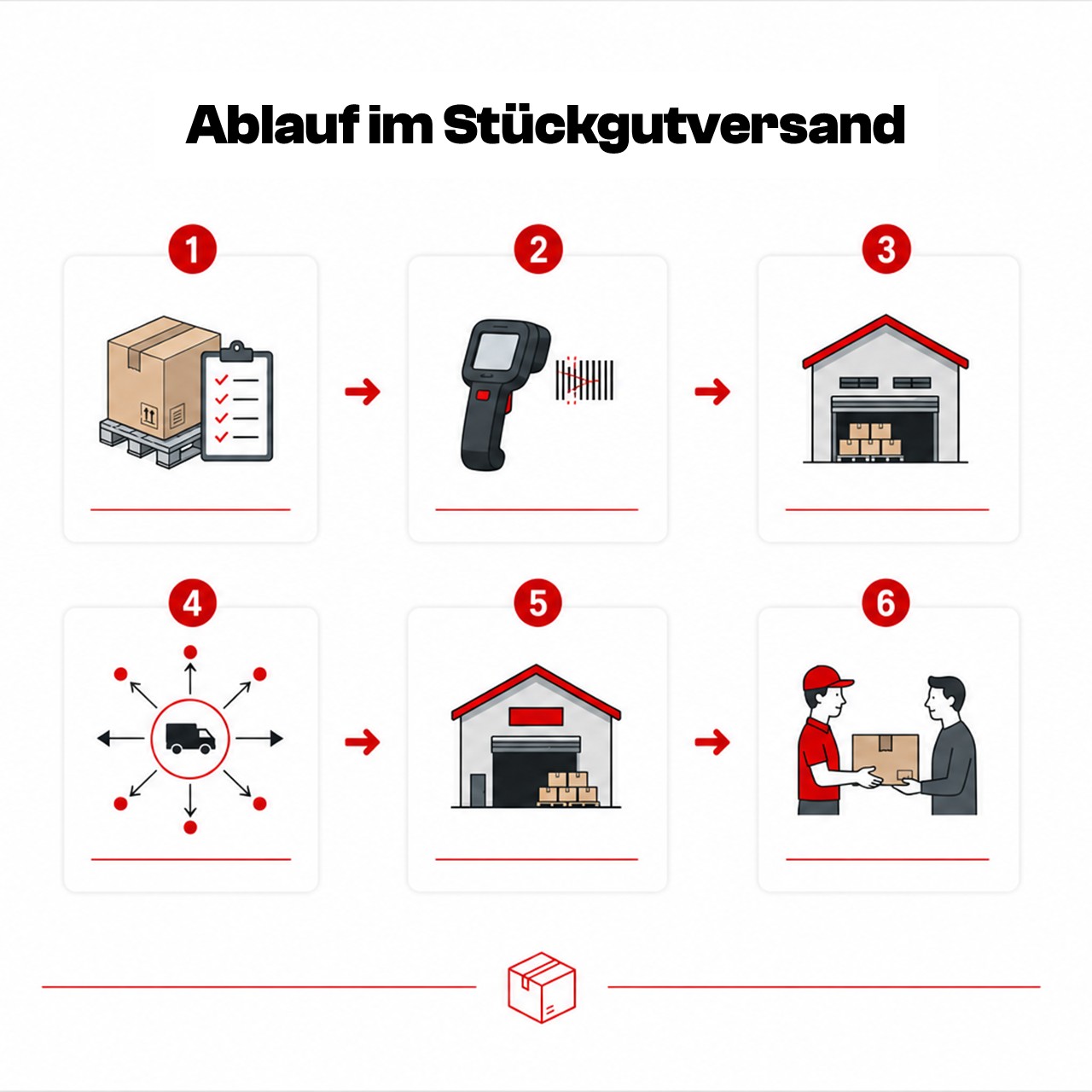
The process can be broken down into several steps:
1. Preparing the shipment
Before shipping, goods must be packed securely for transport and clearly labeled. This includes sturdy packaging, clearly visible shipping labels, and complete details regarding the sender, recipient, dimensions, weight, and type of goods. If a shipment is non-stackable or has special requirements, this should be clearly marked.
2. Collection from the sender
The prepared groupage shipment is collected from the sender. Depending on the size of the shipment, this may involve individual boxes, pallets, crates, or other packages. After collection, the goods are transported to the nearest transshipment terminal.
3. Handling at the depot
At the depot, the shipment is checked, sorted, and assigned to the appropriate destination area. Many different groupage shipments are collected here and prepared for further transport. It is crucial that every shipment is clearly identifiable and that all information is complete.
The Emons network of locations and depots allows groupage shipments to be connected regionally, bundled, and prepared for onward transport.
4. Main haul within the transport network
After handling, the goods are bundled with other shipments and transported toward the destination region. This main haul usually takes place via fixed scheduled services or defined transport routes. Bundling allows for efficient use of loading space.
5. Forwarding to the destination depot
The shipment arrives at the destination depot in the target region. There, it is sorted again and prepared for the final leg of transport. This involves checking which shipments belong to which delivery route.
6. Delivery to the recipient
In the final step, the groupage shipment is delivered to the specified delivery address. Depending on the agreement, special requirements can be accommodated, such as advance notification, a specific time window, or delivery with a tail lift.
Why complete information is important
Accurate information is essential for smooth general cargo shipping. This includes the number of packages, dimensions, weight, type of goods, stackability, as well as the pickup and delivery addresses. The more complete these details are, the better the shipment can be planned, loaded, and delivered.
The advantage of this system lies in consolidation: multiple shipments from different senders are transported together. This allows for better utilization of available loading space without needing a dedicated truck for every single shipment.
What information is important for a general cargo shipment?
For a general cargo shipment, the freight forwarder requires precise details about the goods. This primarily includes the number of packages, dimensions, weight, type of goods, packaging, stackability, as well as the pickup and delivery addresses.
Special requirements should also be mentioned immediately, such as notification, tail lift, time windows, or hazardous goods information. The more complete this information is, the better the transport route, vehicle requirements, and freight costs can be estimated.
For your inquiry, always count the complete package including the pallet, packaging, film, or strapping. Overhangs or non-stackable goods should also be clearly indicated so that the shipment can be planned without issues.
Overhangs should be avoided, as they increase the risk of damage and may require additional space in the truck.
Shipping general cargo with Emons
If you would like to ship general cargo nationally or internationally, Emons will support you with the right transport solution. Depending on the volume of goods, destination region, and requirements, we will determine whether general cargo, partial load, or another shipping solution makes the most sense. For a realistic estimate, accurate details regarding packages, dimensions, weight, stackability, and the pickup and delivery locations are helpful.
FAQ about general cargo and general cargo shipping
What is general cargo in simple terms?
General cargo refers to individual packages or transport units that can be loaded and transported separately. This includes, for example, pallets, cartons, crates, barrels, or wire mesh boxes. The shipment does not fill an entire truck but is usually consolidated with other shipments.
When is general cargo shipping worthwhile?
General cargo shipping is worthwhile when a shipment is too large or too heavy for parcel shipping but does not require a full truckload. This is often the case for individual pallets, smaller quantities of goods, or regular B2B deliveries.
What is the difference between general cargo, partial load, and full load?
General cargo comprises individual packages or pallets that are transported together with other shipments. A partial load already utilizes a larger portion of the loading space but does not yet fill an entire truck. With a full load, a vehicle is used entirely or almost entirely for a single shipment.
What information is required for a general cargo shipment?
Important details include the number of packages, dimensions, weight, type of goods, packaging, stackability, as well as the pickup and delivery addresses. Special requirements such as a tail lift, notification, time windows, or hazardous goods information should also be communicated directly.
How much does general cargo shipping cost?
Costs depend on several factors, such as distance, weight, dimensions, volume, stackability, transit time, and additional services. For an accurate estimate, an individual freight inquiry is therefore recommended.
Can I ship general cargo with Emons?
Yes. Emons supports companies with national and international general cargo shipping. Depending on the shipment size, destination region, and specific requirements, we determine the most suitable transport solution.

.jpeg)