Table of contents
Order picking explained: Learn about the different methods, how the warehouse process works, and what companies should look out for.
In warehouse logistics, order picking determines whether goods are ready for the next process step completely, correctly, and on time. Whether for customer orders, production materials, or shipping: order picking involves retrieving items from inventory and assembling them according to an order. The more clearly the process is organized, the more reliably warehouse, packaging, and distribution operations work together.
Order picking refers to the assembly of items from inventory based on a customer order, production order, or internal requirement. The goal is to provide the right goods in the right quantity and prepare them for packaging, shipping, or further processing.
Would you like to connect your warehouse processes, order picking, and shipping more efficiently? Speak with our experts in logistics and road transport or submit your non-binding freight inquiry directly.
Why order picking is important for warehousing and shipping
Order picking connects inventory, orders, and shipping into a seamless process. Stored goods are transformed into a specific unit ready for packaging, production, further processing, or transport.
This step is particularly important for companies because errors can have a direct impact on subsequent operations. If the wrong item is picked or a quantity is not assembled correctly, it leads to rework, delays, and additional costs.
For order picking to function reliably, you need clear storage locations, up-to-date inventory data, understandable orders, and thorough checks. This allows warehouse, packaging, and shipping operations to integrate better, keeping the entire flow of goods more stable.
How does order picking work in the warehouse?
The order picking process begins with an order. This specifies which items are needed and in what quantities. Based on this, the appropriate storage locations are accessed and the goods are retrieved from inventory.
After retrieval, the check follows. This involves verifying that the item number, quantity, and condition of the goods match the order. The items are then
assembled and prepared for the next process step. This could be packaging, shipping, production, or internal transfer.
The more clearly this process is organized, the lower the risk of errors. Especially when dealing with many items, multiple warehouse zones, or high order volumes, fixed processes, digital support, and a final check are essential. This turns inventory into a complete, ready-to-use unit for shipping, production, or further processing.
What are the different order picking methods?
There are various order picking methods used in warehouse logistics. The most suitable method depends primarily on the warehouse layout, the number of items, order volume, and requirements for speed and accuracy. Fundamentally, the goal is always to retrieve goods from inventory as efficiently as possible and prepare them for the next process step.
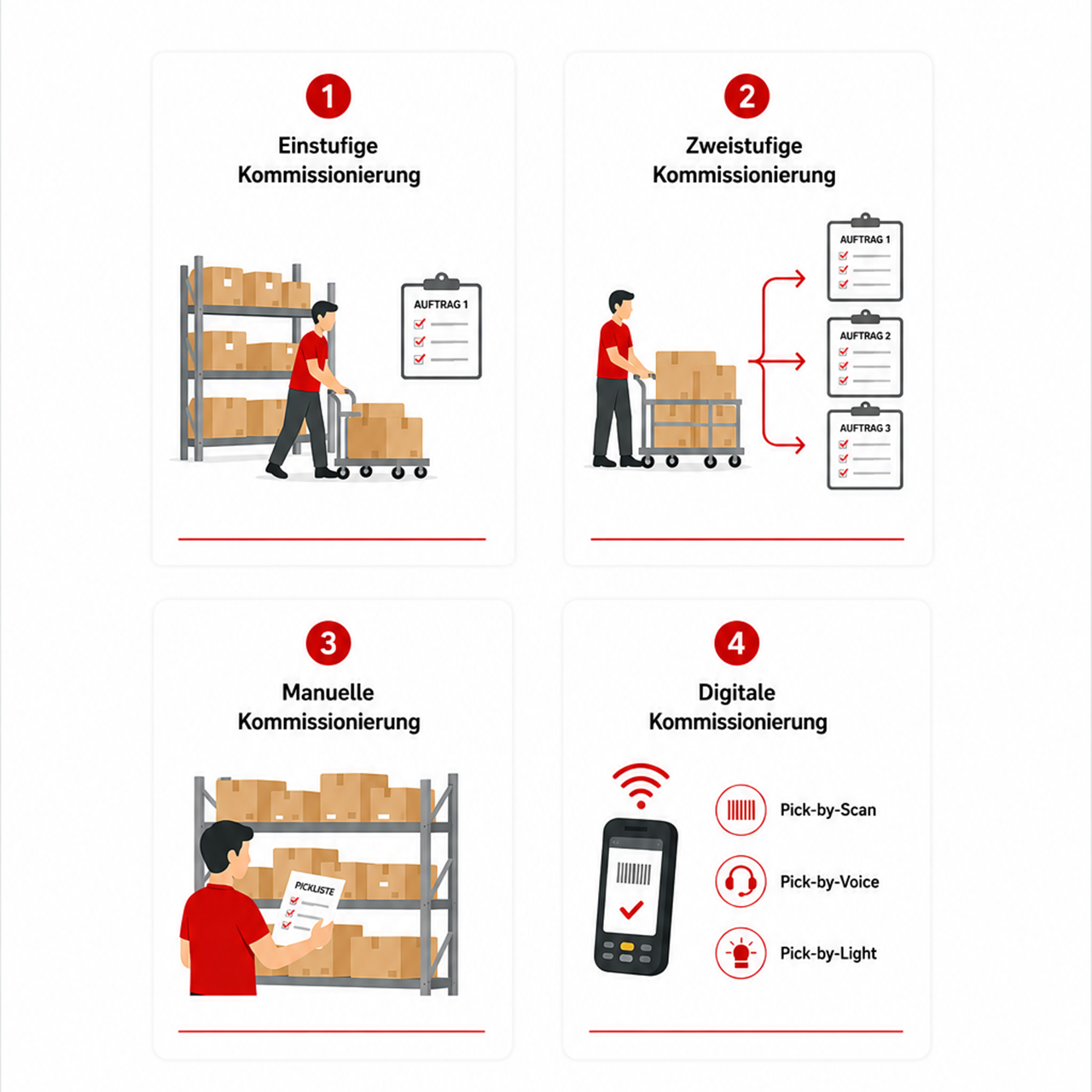
One commonly used method is single-order picking. In this approach, each order is processed individually. The required items are picked directly for a specific order and then passed on. This method is very straightforward and is well-suited for scenarios where orders need to remain clearly separated from one another.
In multi-order picking, items are first collected for several orders at once. In a second step, they are then sorted into the individual orders. This method can be particularly useful when many similar items are needed for multiple orders. It helps reduce travel distances within the warehouse and allows for the consolidation of processes.
A distinction is also made between manual and digitally supported picking. In manual picking, staff work with tools such as pick lists or order slips. Digital methods like pick-by-scan, pick-by-voice, or pick-by-light support the workflow using mobile devices, voice guidance, or light signals at the storage location.
Would you like to find out which warehousing or shipping solution fits your processes? Speak with the logistics experts at Emons or submit your non-binding freight inquiry directly.
Digital picking: Pick-by-scan, pick-by-voice, and pick-by-light
Digital systems can significantly support the picking process. They help manage orders more clearly, reduce errors, and guide staff reliably through the picking workflow. Methods such as pick-by-scan, pick-by-voice, and pick-by-light are particularly common.
With pick-by-scan, staff work with a mobile scanner or handheld device. The required items are displayed digitally and scanned upon retrieval. This allows for immediate verification that the correct item and quantity have been selected.
With pick-by-voice, staff receive picking instructions via voice commands. For example, they hear which storage location to head to and what quantity to pick. The advantage is that their hands remain free and they do not need to constantly look at a list or device.
With pick-by-light, light signals at the storage location indicate which item should be picked. Often, the required quantity is also displayed. This method is particularly suitable for clearly structured warehouse areas with many recurring picking operations.
Person-to-goods vs. goods-to-person
In addition to individual picking methods, there are different fundamental principles regarding how goods and staff interact in the warehouse. A common distinction is made between person-to-goods and goods-to-person.
In the person-to-goods principle, staff move through the warehouse and retrieve the required items directly from the storage location. This is a classic workflow in many warehouses because it is relatively easy to implement. Key factors here are well-structured storage locations, short travel distances, and clear information on where each item is located.
In the goods-to-person principle, however, the goods are brought to the picking station. Staff remain at a fixed workstation and receive the required items via an automated or semi-automated system. This principle can be particularly useful for high order volumes, many small items, or highly standardized processes.
Common errors in order picking
In order picking, small mistakes can quickly have major consequences. If the wrong item is picked, a quantity is miscounted, or a shipment is incomplete, the entire subsequent process is often delayed. This affects not only the warehouse itself but also packaging, shipping, production, and delivery to the customer.
Errors often arise from unclear storage locations, outdated inventory data, or incomplete order information. Long walking distances, time pressure, or poorly legible pick lists can also lead to items being mixed up or quantities being recorded incorrectly.
Another key point is the lack of verification at the end of the process. Without a final check between the order and the assembled goods, errors often go unnoticed until the shipment has already been packed or sent. This results in rework, inquiries, and additional costs.
To avoid such errors, clear storage structures, up-to-date data, easy-to-understand work instructions, and appropriate digital support are helpful. It is also particularly important that employees know what to look for regarding item numbers, quantities, packaging units, and special requirements. This makes picking more reliable and the entire flow of goods more stable.
Improving picking in practice
For picking to function reliably, warehouse processes should be regularly reviewed and adapted to actual requirements. The decisive factor is not just which method is used, but how well the warehouse structure, inventory data, employees, and technology work together.
One important approach is the clear organization of storage locations. Items that are needed frequently should be as accessible as possible. Rare or bulky goods, on the other hand, can be stored in less central areas. This reduces walking distances and allows orders to be processed faster.
Up-to-date inventory data also plays a major role. If stock levels are incorrect, errors occur even before the actual picking begins. Digital systems can help make goods movements more transparent and manage orders more effectively.
In addition, verification at the end of the process should not be overlooked. A quick check of the item, quantity, and order can prevent incorrect or incomplete goods from being passed on. This makes picking more stable and ensures that subsequent processes such as packaging, shipping, or production run more reliably.
Which digital solution makes sense depends on the warehouse processes. Key factors include the item structure, order volume, error susceptibility, and the desired level of automation. It is important not only to consider the technology itself but also how well it is integrated into existing workflows.
Connecting picking and logistics efficiently
Well-organized picking is a key building block for stable warehouse and shipping processes. When goods are correctly assembled, checked, and prepared for the next step, packaging, transport, and delivery also benefit.
Emons supports companies in effectively connecting warehouse logistics, picking, and transport. Depending on the goods structure, order volume, and shipping requirements, various logistical solutions can be relevant – from classic warehousing and value-added services to efficient handling processes like cross-docking.
Would you like to efficiently connect your warehouse logistics, picking, and shipping processes? Speak with the logistics experts at Emons or submit your non-binding freight inquiry directly.
Picking FAQ
What does picking mean in simple terms?
Picking means that items are retrieved from warehouse stock and assembled according to an order. The goal is to provide the right goods in the right quantity for shipping, production, or further processing.
What picking methods are there?
Well-known methods include single-stage and two-stage picking, as well as manual and digitally supported processes. Digital methods include, for example, pick-by-scan, pick-by-voice, or pick-by-light.
What is the difference between person-to-goods and goods-to-person?
In person-to-goods, employees move through the warehouse and pick items directly from their storage locations. In goods-to-person, the goods are brought to a picking station, allowing employees to work from a fixed workstation.
Why is order picking important?
Order picking is important because it determines whether goods are available completely, correctly, and on time for the next process. Errors can lead to rework, delays, higher costs, or incorrect deliveries.
How can order picking be improved?
Order picking can be improved through clear storage locations, up-to-date inventory data, easy-to-understand orders, digital support, and a final check. It is crucial that the process matches the warehouse structure and order volume.
What is the difference between order picking and cross-docking?
In order picking, items are retrieved from inventory and assembled according to an order. In cross-docking, however, goods are transshipped as directly as possible after receipt, without being stored long-term. While order picking works from inventory based on specific orders, cross-docking focuses on rapid goods turnover.
.jpeg)