Table of contents
In international trade, many questions must be resolved before shipping: Who organises the transport? Who bears which costs? When does the risk transfer from seller to buyer? This is exactly where Incoterms 2020 help. They create clear rules for delivery terms and make international transport easier to plan.
Incoterms are particularly important for companies when goods are shipped across borders. Depending on the clause, responsibilities, cost distribution and duties regarding transport, insurance and customs differ significantly.
Incoterms 2020 are internationally used delivery terms for the trade of goods. They define the obligations that sellers and buyers assume during transport, who bears which costs, and the point at which the risk for the goods transfers. Incoterms do not replace individual contract review, but they do help to define delivery terms in a uniform and understandable way.
Are you planning an international shipment and would like to clearly define costs, risk and customs? Speak to our international shipping experts or submit your non-binding freight enquiry directly.
Why are Incoterms 2020 important for international shipping?
Incoterms 2020 are important because they create clear responsibilities in international shipping. They regulate which tasks the seller and buyer assume, who bears which costs, and the point at which the risk for the goods transfers. This helps to avoid misunderstandings and makes transport easier to plan. The ICC describes the Incoterms rules as an internationally recognised foundation for clearly assigning tasks, costs and risks between seller and buyer.
This clarity is crucial, especially for cross-border shipments. Transport costs, insurance, export clearance, import clearance and customs can be distributed differently depending on the Incoterms clause. If the wrong clause is chosen or not clearly agreed upon, it can quickly lead to queries, delays or unexpected costs.
For companies, Incoterms 2020 therefore help to make quotes, contracts and transport agreements more comparable. However, it is important to note that Incoterms do not replace individual contract review. They provide a standardised basis for delivery terms, but should always be selected to suit the specific shipment, the transport route and the agreements between buyer and seller.
What do Incoterms 2020 not regulate?
Incoterms 2020 do not regulate the entire sales contract. Payment terms, transfer of ownership, product liability or individual customs requirements must be clarified separately. In practice, this means that the Incoterm should always be checked in conjunction with the named place, the transport route and the specific contractual agreements.
Which Incoterms 2020 are there?
Incoterms 2020 comprise a total of 11 clauses. These include EXW, FCA, DAP and DDP, which often play an important role in international shipping. Each clause defines differently which tasks the seller and buyer assume, who bears transport costs, and the point at which the risk for the goods transfers. The International Chamber of Commerce describes the Incoterms 2020 as rules for the clear assignment of obligations, costs and risks between buyer and seller.
For companies, it is particularly important not to see the clause merely as an abbreviation. Behind every Incoterms rule lies a specific distribution of responsibility. With some clauses, the buyer assumes many tasks very early on, while with others, more responsibility lies with the seller.
In practice, it is therefore worth taking a close look at the respective delivery term. A clause may seem suitable at first glance, but may require additional coordination depending on the transport route, customs clearance or insurance requirements. Especially for international shipments, purchasing, sales, logistics and shipping departments should therefore work together to check which Incoterms clause is suitable for the specific delivery.
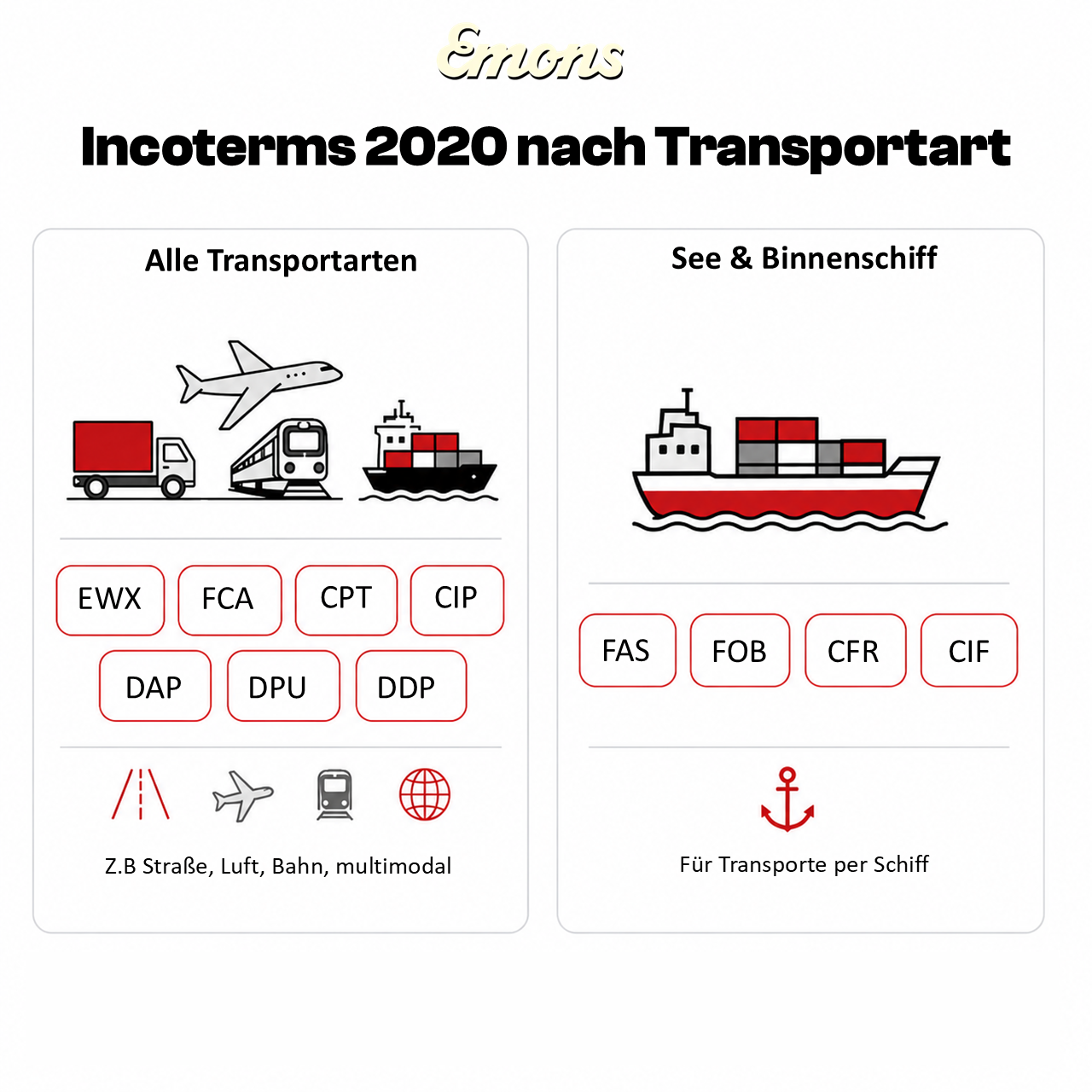
The list provides an overview of all 11 Incoterms 2020. In practice, clauses such as EXW, FCA, DAP and DDP are particularly relevant for many companies, as they are frequently used in international road transport or multimodal transport. For sea and inland waterway transport, FAS, FOB, CFR and CIF also play an important role.
Costs, risk and customs: what companies should look out for
Incoterms 2020 are not just about who pays for transport. The distinction between costs, risk and customs obligations is particularly important. For example, one party may cover certain transport costs, while the risk of loss or damage to the goods transfers at an earlier point. Therefore, it is essential to always check exactly which Incoterm has been agreed and which named place is associated with it. The ICC describes Incoterms 2020 as rules for the clear allocation of obligations, costs and risks between buyer and seller.
A clear agreement is also important for customs. Depending on the clause, either the seller or the buyer may be responsible for export or import formalities. Incoterms define who assumes which responsibility, but they do not replace the need to check specific customs requirements. Especially with international shipments, additional documents, permits or country-specific regulations may be relevant. For companies, this means that Incoterms 2020 should not be viewed in isolation. Purchasing, sales, logistics and shipping departments should work together to check whether the chosen clause is suitable for the goods, the transport route and the destination country. This helps to avoid misunderstandings and better prepare for international transport.
Are you unsure which Incoterms clause is suitable for your shipment, or would you like to plan your transport costs and processes in detail? Submit your no-obligation freight enquiry to Emons
Incoterms 2020 by mode of transport: which clause is suitable for what?
The choice of the appropriate Incoterms clause depends heavily on the transport route. For road transport, air freight, rail transport and multimodal transport, the rules for all modes of transport are primarily considered. For pure sea and inland waterway transport, however, FAS, FOB, CFR and CIF play a special role.
It is always crucial that the Incoterm, the named place and the actual transport chain match.
Avoiding common mistakes with Incoterms 2020
When using Incoterms 2020, errors often arise not from the clause itself, but from unclear information. The named place is particularly important. An Incoterms clause should therefore not only be stated as an abbreviation, but always with the specific location, for example, warehouse, port, terminal or delivery address.
Another common mistake is confusing the transfer of costs and the transfer of risk. Just because one party covers certain transport costs does not automatically mean that they also bear the risk up to that point. Companies should therefore always check exactly when the risk of loss or damage to the goods transfers from the seller to the buyer.
The mode of transport should also match the chosen clause. Some Incoterms 2020 can be used for all modes of transport, while FAS, FOB, CFR and CIF are specifically intended for sea and inland waterway transport. The ICC distinguishes the rules accordingly between "any mode(s) of transport" and "sea and inland waterway transport".
It is also important not to equate Incoterms with a complete contract. They regulate key points regarding transport, costs and risk, but do not replace individual agreements on payment, transfer of ownership, product liability or customs details. It is therefore worthwhile for companies to coordinate Incoterms 2020 with their purchasing, sales, logistics and, if necessary, customs departments.
Correctly classifying Incoterms 2020 in practice
For international shipments, the chosen Incoterms clause should also be logistically suitable for the shipment. Decisive factors include the transport route, destination country, type of goods, customs clearance and the agreed point of delivery.
Emons AIR&SEA supports companies in preparing international transport appropriately and classifying the chosen delivery terms logistically. Depending on the transport route and destination region, solutions in international road transport, air freight, sea freight or a combination of different modes of transport may be relevant.
Would you like to plan your international shipments more effectively? Speak to the experts at Emons or submit your no-obligation freight enquiry.
FAQ on Incoterms 2020
What are Incoterms 2020 explained simply?
Incoterms 2020 are internationally recognised trade terms used in the sale of goods. They define the obligations of both seller and buyer regarding transport, who bears specific costs, and the point at which the risk for the goods transfers.
How many Incoterms 2020 are there?
There are 11 Incoterms 2020 in total. They are divided into rules for any mode of transport and rules specifically for sea and inland waterway transport.
Who bears the costs under Incoterms 2020?
That depends on the agreed Incoterms rule. With some rules, the buyer takes on many costs early on, while with others, the seller bears transport costs up to a specific location. It is therefore always important to check the Incoterm in conjunction with the named place.
When does the risk transfer to the buyer?
The transfer of risk is regulated differently depending on the Incoterms rule. It can occur as soon as the goods are made available, upon handover to the carrier, or only at the named destination. For this reason, the transfer of costs and the transfer of risk should not be confused.
Which Incoterms 2020 are suitable for all modes of transport?
EXW, FCA, CPT, CIP, DAP, DPU and DDP are suitable for all modes of transport. These rules can be used for road haulage, air freight, rail transport or multimodal transport, for example.
Which Incoterms apply only to sea and inland waterway transport?
FAS, FOB, CFR and CIF are intended specifically for sea and inland waterway transport. They refer to delivery points such as alongside the ship, on board the vessel, or the port of destination.
Do Incoterms 2020 replace a contract?
No. Incoterms 2020 regulate important aspects regarding transport, costs and risk, but they do not replace a full contract. Payment terms, transfer of ownership, liability issues or specific customs requirements must be checked and agreed upon separately.

.jpeg)